
Dear Friends,
I like that the Song of the Week has two question marks. No, that’s not a typo. It is demanding your attention through a repeated refrain. Both declarative and appropriate for Memorial Day in the US.
We have good reports and charts to share from this week, so please don’t mind me leaving passive investing, indexes, and massive IPOs for the future.
Today's Contents:
Sensible Investing
Weeklies: Pictures & Song
Sensible Investing
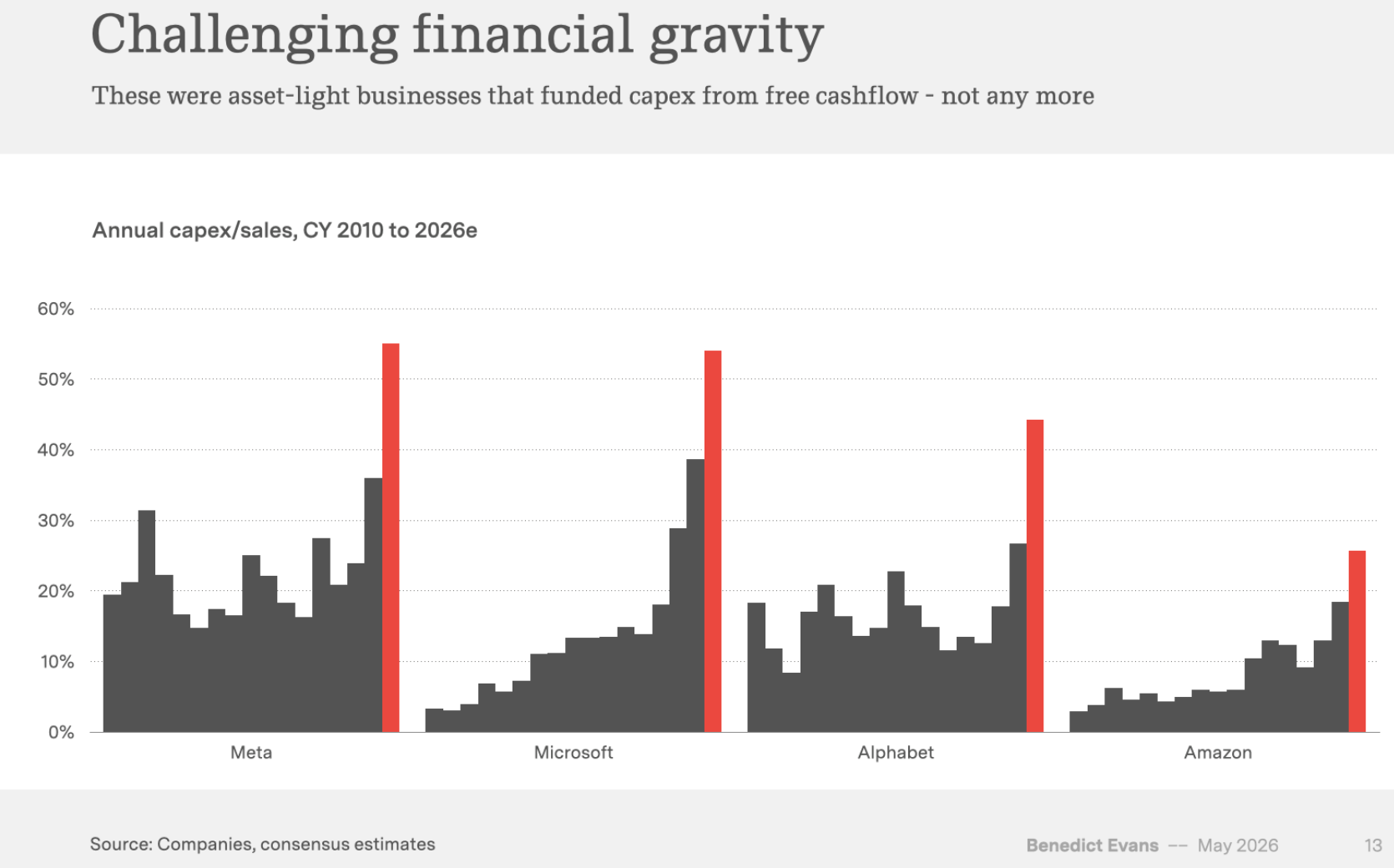
AI Eats the World - Latest Ben Evans presentation, though the big questions and trends (e.g., Will LLMs have pricing power?) have not changed in the last few years. It is still dramatic to see the data as presented.
PS. I don’t believe that Anthropic is profitable by any normal accounting standards.
JP Morgan’s Guide to Alternatives is worth a browse. Nothing surprising IMHO.
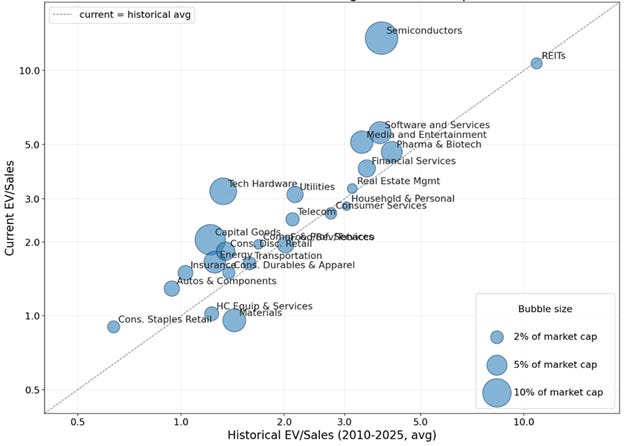
Priced for Perfection: AI Speculative Mania Is In Full Swing from Verdad. Arguing that semiconductor stocks are overpriced and a large part of the market. I’ve often found Dan Rasmussen compelling, but time has not always proven him correct. Maybe this time.
I liked this interview with a Siemens employee about the high demand for energy equipment, which has led to margin increases from 4-6% to 30-40%. I have seen quite a few founder-types price these forward margins as a go-forward assumption - while I assume it will be a temporary crunch, and many solutions for power and efficiency will come online around the same time.
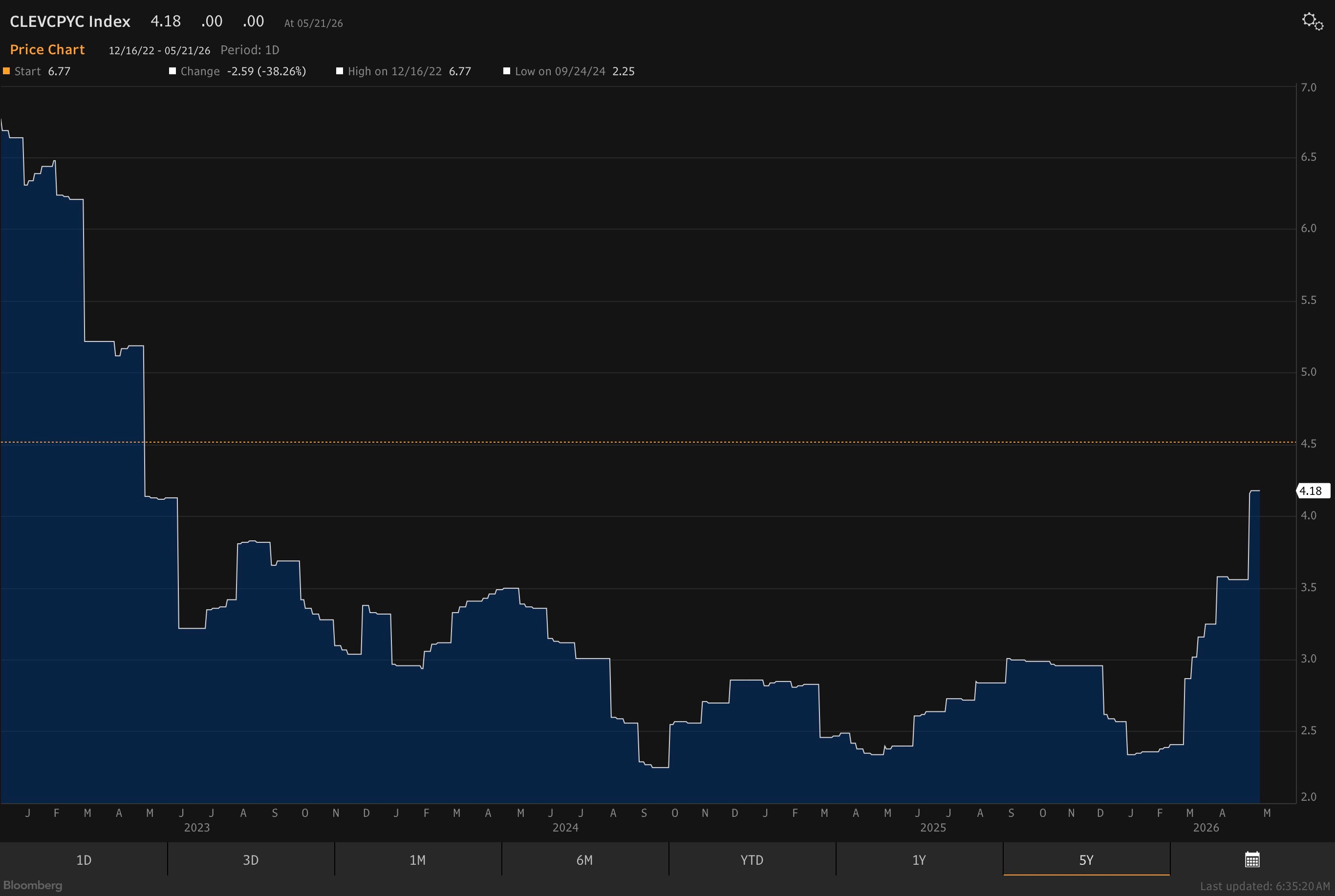
Given all the market euphoria, the word ‘bubble’ keeps coming up. The way most capital market parties end is with interest rates and bond market activity. This week, the Cleveland Fed’s inflation gauge is coming in at 4.18% annual for May (see below), with many people believing this is an underestimate due to Iran War-related supply constraints and rising energy costs. And there is plenty of hand wringing in the FT, Bloomberg, and other trade press on the outlook for bonds. We’ll watch this space.
EdTech stuff: Thoughts on ‘screen time.’
Pushback against education technology and screen time is fairly cyclical, but we are now in a time of skepticism. I find that most of these pieces are broad-brush strokes of ‘EdTech’. There are several things going on.
First, incumbents with legacy products master procurement processes that have a long checklists of requirements that usually result in the lowest common denominator products (‘one product fits most’), which means it serves no one individual or situation truly well. You need to, instead, have more nimble procurement and use of various tools. I-Ready has been the recent target, as described in ChalkBeat. It’s owned by Curriculum Associates, which was founded in 1969 by four educators creating print instructional materials for K-12 education. Now it’s backed by private equity.
Second, parents will always have strong opinions without much reasoning, like this article in New York Magazine that has an anecdote about Amira Learning, which is not a legacy product, and, although I haven’t looked deeply, seems best in class. The parents have no real objection to it other than the aphorism that ‘screen time is bad.’
Third, much EdTech efficacy research is not replicable. One reason is that academics don’t like to acknowledge the variation between ‘quality of leadership/teaching’, ‘system capacity’, or implementation quality, and their relation to outcomes. They see that as a variable to remove rather than a key driver of the outcome in tandem with a solution. These randomized controlled trials on a narrow intervention never end up being that directionally helpful. That’s why one should focus more on how the product is being used systematically.
Fourth, implementation and nuance are everything, obviously. Screen time, when it happens, needs to count. Watching a YouTube video for gym class isn’t aspirational. Neither are endless iPad games when something social and tactile can do the trick. But that doesn’t mean you throw it all away.
If you are using screens, you should go fully immersive and interactive, like Prisms, which puts pedagogy at the center of its product (an immersive reality science and math curriculum that uses spatial reasoning and real-world scenarios) and focuses heavily on the teacher dashboard.
In 2013, I was a thought leader on effective EdTech implementation and published an index in a paper with Nesta, a UK-based research and innovation foundation, and my co-author, Michael Fullan, is one of the leading academic practitioners in whole-system education reform. Today, in the year 2026, we don’t care about experts anymore, but this is good intellectual work in a field with limited rigor, and it's still highly relevant today.
Lastly, this guy is right, parents really matter. That means they matter in both the tech and non-tech scenarios, too.

Weeklies: Selfie & Song
Selfie
When my grandfather passed a few months ago, the military issued our family a burial flag. These are given to all who have served in the US military, and my grandfather served for a few years in the Navy after college. My mother let me be its guardian. I am well aware that most 40-year-old women do not come into possession of one of these because their grandfather drew his last breath surrounded by family at age 93 in suburban Minneapolis. I am fortunate for that.

When I was last in San Francisco, I decided to walk to a meeting in the Presidio, passing through one of the most beautiful cemeteries in America.
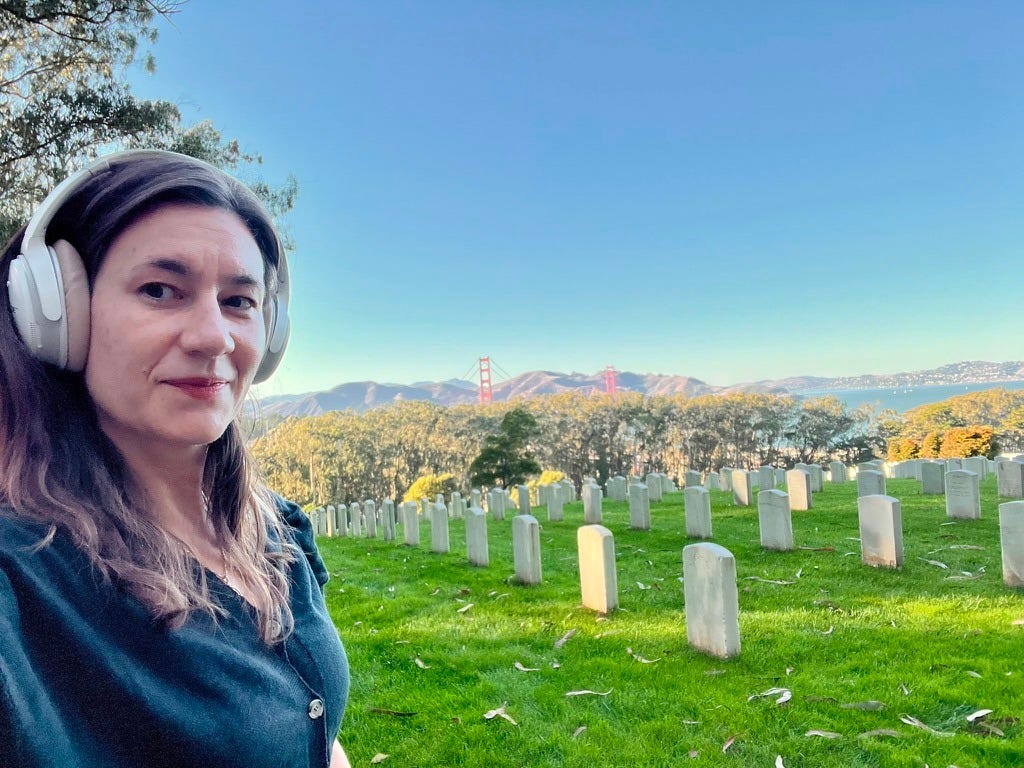

Etched into the stone are the final stanzas from The Young Dead Soldiers Do Not Speak:
They say: We have given our lives but until it is finished
no one can know what our lives gave.
They say: Our deaths are not ours: they are yours,
they will mean what you make them.
They say: Whether our lives and our deaths were for
peace and a new hope or for nothing we cannot say,
it is you who must say this.We leave you our deaths. Give them their meaning.
We were young, they say. We have died; remember us.
Yes, that’s heavy stuff to think about on the way to some startup/VC meeting.
I recently had a conversation with a successful friend in technology who could retire several times over. He was temporarily stepping into a leadership role at a strong but all-consuming company. There were aspects of his workload he was struggling with, and I asked him what was most important to him. Why was he even doing this? He wanted to be ‘in service’ to others. I was struck because I almost never hear this as the reason for labor. We live in a world of optimization, of securing the bag before underclass doom, of constant competition and consumption. Who has the time or interest to be ‘of service’ anymore?
Packy at Not Boring published a recent essay called Riding the Leopard where he proposes to an audience of technologists that the meaning of life is ‘to experience’ and that fulfilling your personal ‘differentiation is a moral obligation’. That is indeed one way and certainly in the zeitgeist. But it feels incomplete. That’s a solo mission.
However, an important, often-overlooked alternative framework is that the meaning of life lies in being of service to others (including family, friends, community, country). The more successful, the more capable, the wealthier, the more important, and potentially meaningful being in service could be. Maybe one reason people are supposedly unhappy and lack meaning is that being ‘in service’ is out of vogue.
As Roy Spence, a longtime advertising executive, said about Austin: "Here you have the freedom to be me and the responsibility to be us."
Not that I have all the answers, but I hope it’s a point to think about in remembrance of those who served and sacrificed their lives as we give meaning to this Memorial Day in 2026.
Song of the Week: Do You Realize?? By The Flaming Lips

Here on YouTube.
This song, often cited as one of the best in the modern era, is a reflection on the meaning of life. Optimistic and probing.
Do you realize
That everyone you know someday will die?
And instead of saying all of your goodbyes
Let them know you realize that life goes fast
It’s hard to make the good things last
The structure of the song moves between questioning and answering like a conversation with someone who needs to be reminded of what they already know.
Thanks for reading, friends. Please always be in touch.
As always,
Katelyn
Has anyone offered any particularly good reasons as to why Meta needs to get into AI?
Google has to be there
Amazon has a lot to gain selling AI'AAS
For MS, there is a defense and offense to play.
Meta is a media owner, they make money from ads, against content people upload for free. Unless you're try really really hard to see it, there's NO threat, and Zero opportunity, unless they're just bored of everything they exist for.
"Founder" is the most detrimental term to the VC industry, someone should invent codewords ~ too many on the X timeline are obsessed with acquiring it which leads to a weird call for startups loop