
Dear Friends,
In the movie Bugonia, a pharmaceutical CEO is kidnapped by a conspiracy theorist who believes she's an alien from Andromeda sent to destroy humanity.
Brilliantly acted by Emma Stone, the Andromeda leader issues her verdict on humans: cruel, conflict-ridden, and ecologically destructive. Jesse Plemons has been right all along.

At the end of the film, she pops a bubble over a model of the Earth and every human being dies instantly, mid-motion. The camera pans over the scenes while Marlene Dietrich sings “Where Have All the Flowers Gone?” Written by Pete Seeger, inspired by a Cossack lullaby: flowers picked by girls, girls taken by husbands, husbands taken by the army, husbands into graves, flowers on the graves. A closed cycle.

The refrain asks: When will they ever learn? Implying: someday.
I’d answer: Never. They will never learn.
That’s realistic and okay. A moral judgment that humans are inherently evil is beside the point. Human history is competition and conflict, and technology and cooperation give civilizations survival advantages. It’s empirical.
Many people found the film a depressing critique of humanity. I’d rather be pragmatic. These are manageable human problems, and that’s why deterrence and defense are a worthy investment.
Bugonia has the lesson subtly built in - although the conclusion is mine, not the director's, who wanted to film at the Acropolis.
The closing scenes were shot on the white volcanic rock of Sarakiniko, on the island of Milos. Milos is ancient Melos. In 416 BC, Athens arrived at Melos, and Thucydides recorded the Melian Dialogue: the strong do what they can, the weak suffer what they must. The Melians asked to stay neutral. Athens killed the men anyway and enslaved the women and children.
Realism is a discipline, and for investors it is a profitable one. The only peace to be made is with the way the world works.
The invoice for ‘never learning’ is here.
The world spent $2.9 trillion on its militaries in 2025 — the highest share of global GDP since 2009 (SIPRI, April 2026). European military spending has doubled since 2016. Germany is now the fourth-largest military spender, behind the US, China and Russia.
NATO has committed to 5% of GDP by 2035: 3.5% for core defense plus 1.5% for defense-adjacent spending (e.g., infrastructure, resilience, the industrial base).
In the U.S., Congress appropriated $839 billion for the Pentagon in FY26; the national defense topline crosses a trillion dollars once you add DOE nuclear and reconciliation money. President Trump asked for $1.5 trillion for FY27.
The TAM is large.
The interesting number isn't the budget, but the multiple difference.
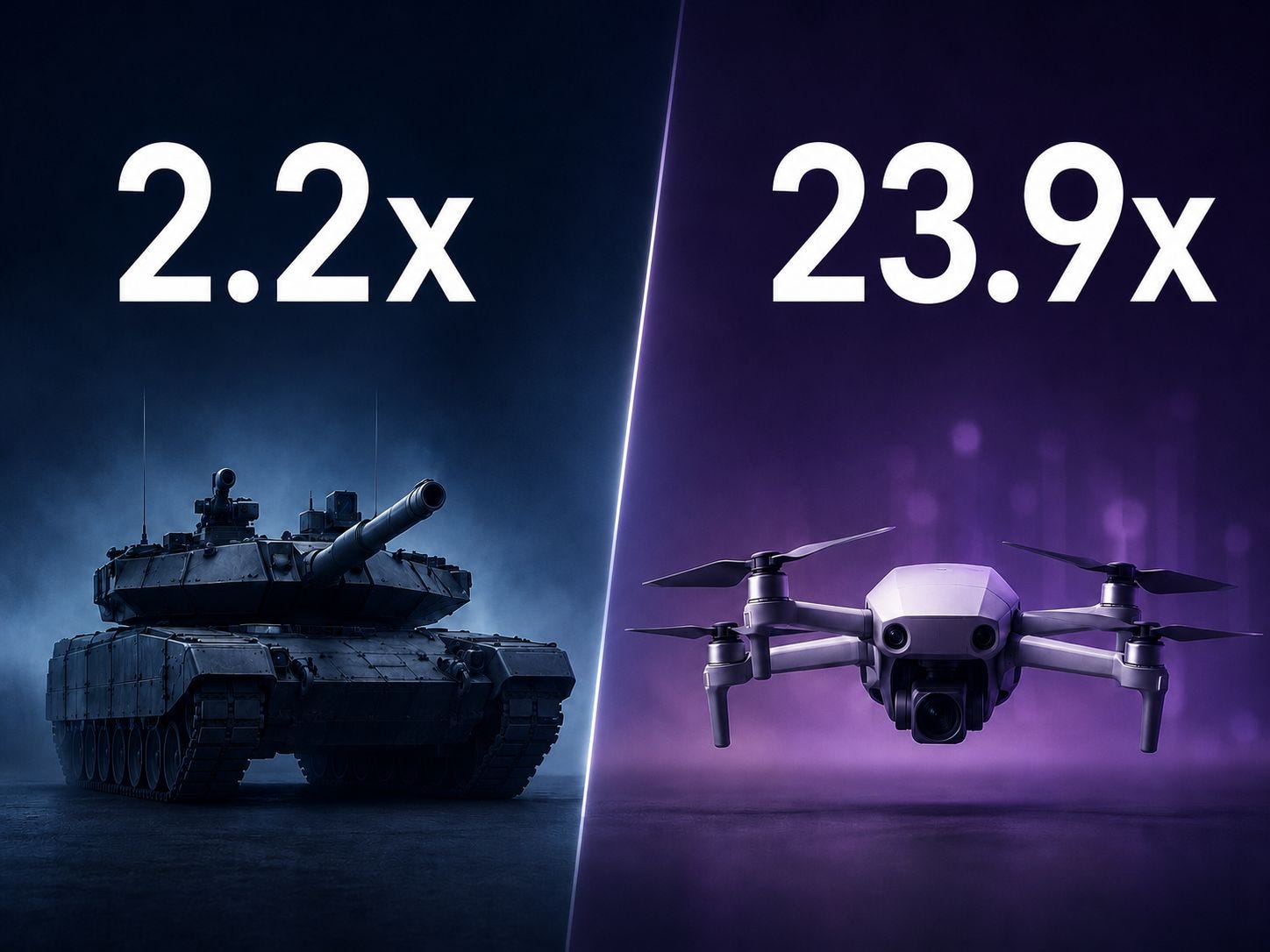
Defense primes trade at a median 2.2x revenue. Defense-tech startups are valued at a median 23.9x (Alex Shmulovich, Viola Ventures referenced on LinkedIn). The revenue base and growth rates are obviously at a dramatically different scale, but that’s not the important 10x difference.
Today, traditional primes have a high backlog-to-revenue ratio, which tells you how much demand has piled up against how much a company can actually build in a year:
Elbit: 3.5x ($28.1B backlog on $7.9B of 2025 revenue), up from roughly 2.1x a decade ago
Lockheed: 2.6x ($194B on $75.0B)
Rheinmetall: 6.4x (€63.8B on €9.9B)
Note: Rheinmetall's disclosed "Rheinmetall Backlog" includes expected call-offs from framework agreements, not only firm orders. Elbit and Lockheed report conventional backlog. Rheinmetall's figure is the most generous but it’s still climbing.
Legacy defense is having its best years in a generation, but defense startups are where the excitement is. That’s both because record backlogs show a production issue for primes that is accumulating faster than they can convert them, and because primes aren’t competing in the new unit economics of war.
The bar is the unit cost of deterrence.
This is how the constraint actually gets broken, and it is the only version of the bet I find underwritable.
Deferred maintenance is always repaid with interest, plus a war premium. A $2 million interceptor against a $20,000 drone is a losing trade. The question for any defense company is: what does a unit of deterrence cost, and can you cut it by ten?
The 10x valuation gap is a bet that new entrants can break the constraint the primes cannot. How? Attritable autonomy. Cheap mass production. AI-driven everything.
Watch backlog-to-revenue over the next couple of years, which will get us into the next US presidential election. If the ratios keep climbing, the incumbents can’t convert demand, and the premium is earned. New production capacity is the scarce asset, and whoever supplies it gets paid. If the ratios compress while primes hold margin, the incumbents solved it themselves with capex and second shifts, and defense-tech investors paid 10x for a bottleneck that cleared on its own. These young companies will face the same execution challenges.
Are you ready for venture-backed lethality? It’s been here a while
A few years ago, I met a young founder of an AI-enabled missile startup who had a clever jingle about fine-tuning his munitions to find foreheads. Sadly, I was distracted by the grin on his face and the glee in his voice and missed committing the tagline to memory. He has since raised funding through credible firms, and the category now writes blog posts about the opportunity in “venture-backed lethality.”
Lethality — how capable something is of causing death — is a Pentagon term for performance and efficiency. Intellectually, the usage is correct, but the messaging needs to be more careful. Not all heat-seeking missiles are in metal casings in the military's exclusive hands.
Four years ago I watched Palmer Luckey make the moral case for defense tech at the first All-In Summit. He was the first to articulate a persuasive public moral case broadly, and the narrative still carries most of the companies that followed him.
Venture has since gone all in.
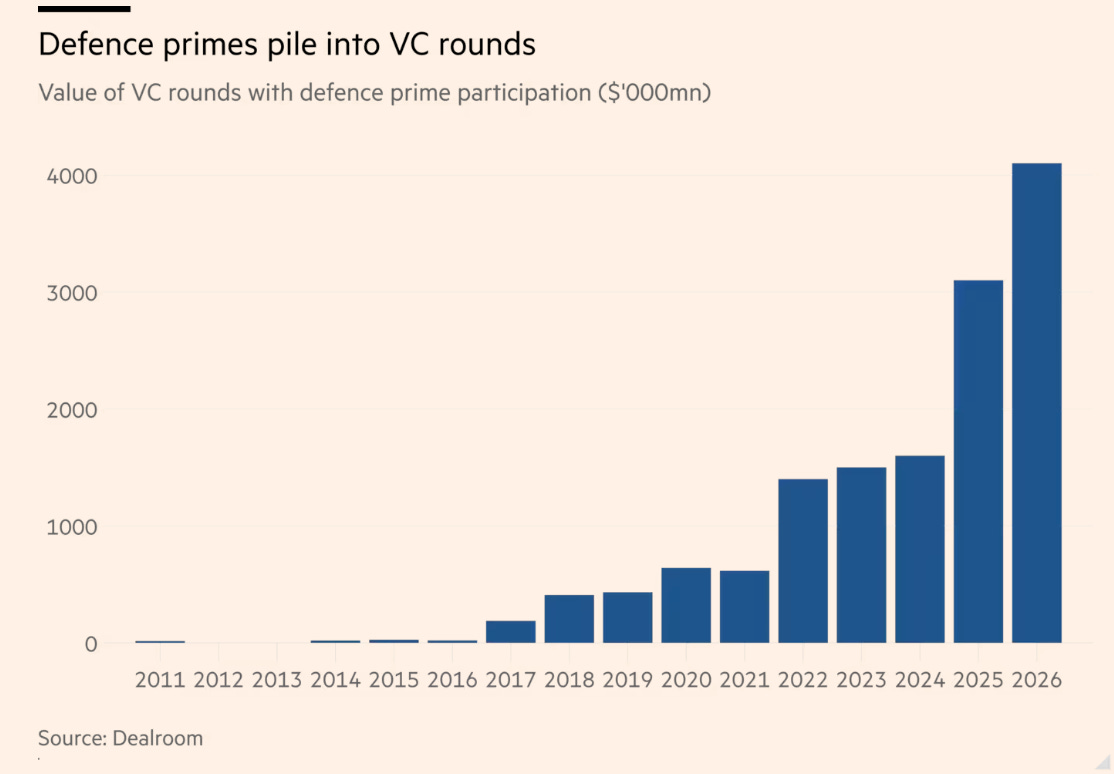
Defense-tech deal value hit roughly $50 billion across 966 deals in 2025, +80% from the prior year, on PitchBook’s definition. Others have a narrower definition. Crunchbase counts $7.7B for the same year; CB Insights $17.9B. In May, Anduril raised a $5 billion Series H at a $61 billion valuation, roughly doubling in a year, and chatter suggests fresh capital at $100 billion. Roughly one venture dollar in twelve now touches defense. The category has widened from munitions to everything underneath them: autonomy, sensing, space, shipbuilding, nuclear power, hardened compute, the machines that make the machines.
Will VCs win? Some of them, probably. But valuations have risen quickly, and people seem to forget defense hardware is capital intensive. These companies will need debt, and the cost of that debt is a real variable.
The primes aren’t going away and are active investors in this tech innovation cycle.
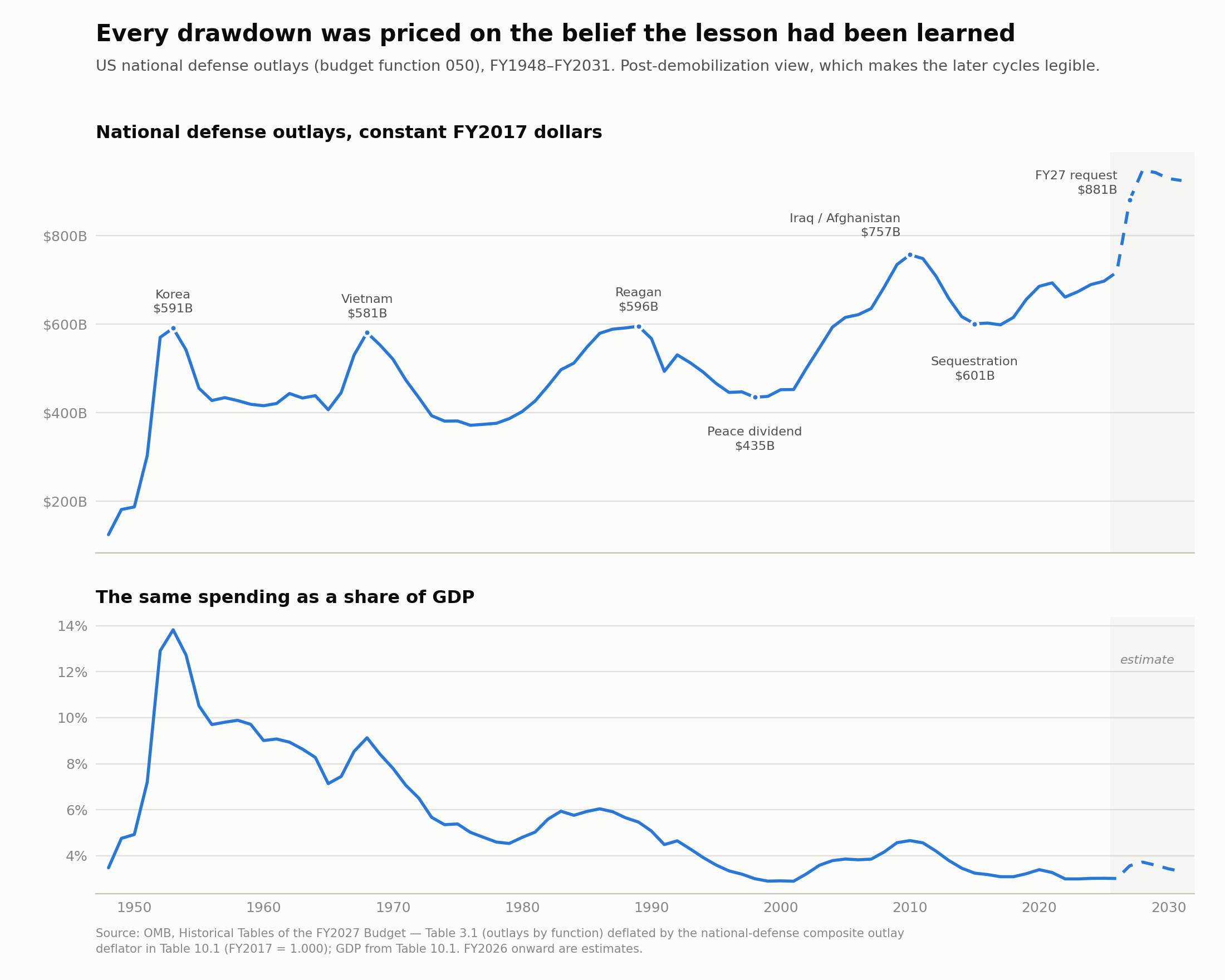
Defense is cyclical. That’s a feature.
Since 1945: demobilization, Korea, drawdown, Vietnam, drawdown, Reagan, peace dividend, the 9/11 surge, sequestration, now today with Russia & Ukraine, Iran, and looming China. Every drawdown rests on the belief that this time the lesson has been learned. Every rearmament is the market conceding it hasn’t. The cycle is why ‘this time is different’ will never apply.
Today, the buildup is in the request; the current rearmament is still, for now, a promise on paper. So, we may still be at the beginning of a new cycle of defense spending.
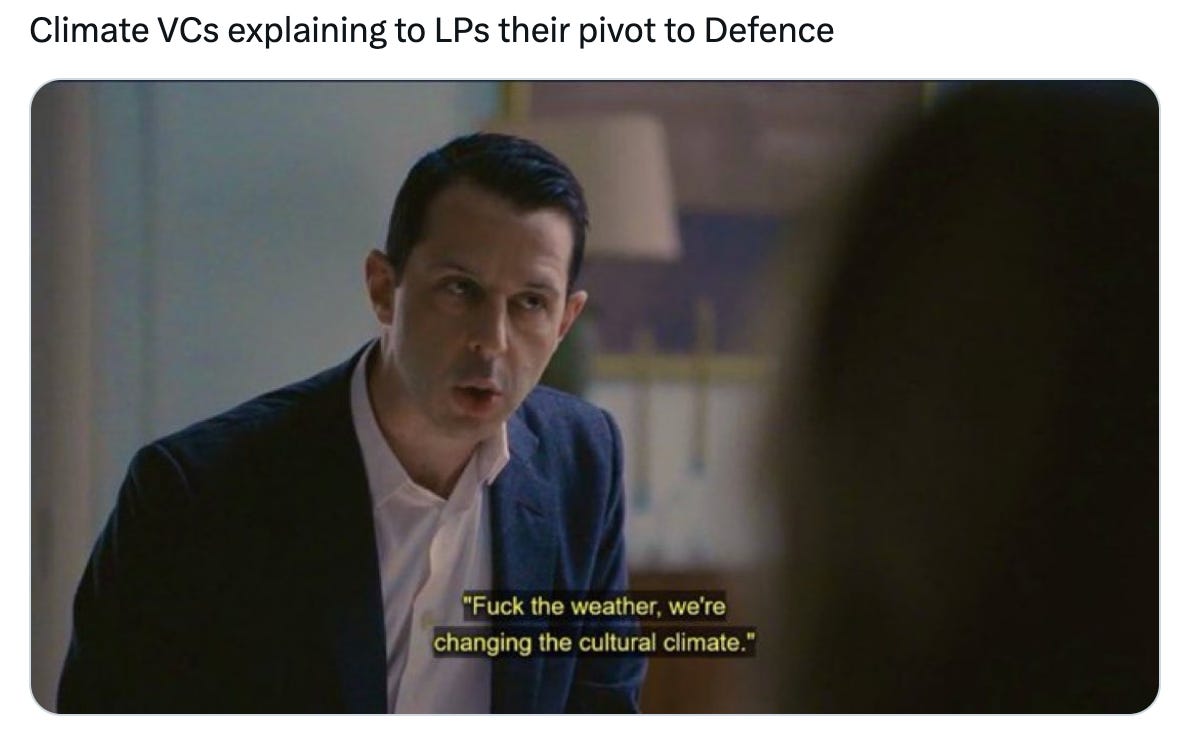
The narrative rotates on the same wave. Climate investors become defense investors, who then become energy/manufacturing investors. Whatever story needs telling gets told, especially when government dollars are the prize. The cycle does what it does. Energy, compute, and advanced manufacturing deter in wartime and compound in peacetime. They have civilian demand underneath them when the winter comes. Invest knowing it comes.
Round, round, round.
The flowers grow on the graves. The girls pick the flowers. The song does not resolve, because it isn't supposed to; it's a round. That's why you should price the cycle honestly, buy the things that compound in peacetime, and be very specific about which bet you're actually making.
Thanks for reading, friends. Please always be in touch.
As always,
Katelyn

PS. No real selfie this lovely Labor Day weekend. I will leave you with this shot of a beautiful live oak in Austin (we did not have these growing up in Minnesota). As AI progress accelerates and Jensen Huang declares AGI has arrived, I find myself enjoying and prioritizing the things with staying power and long-term horizons.
Maybe to the chagrin of my real estate agent: ‘Are we shopping for a house or for some trees?'
Let's start with an 'and,' not an 'or.' The trees will probably outlast the house.
When purchasing (on top of a home inspection) an arborist drilling procedure saves you a TON of money when checking for tree health, to ensure staying horizons I'd hire an arborist when buying a home for a drill sample.
Wonder what you think of SWEBAL and Nordic Air Defense, given that most countries will probably seek domestic/other nations for their defense needs, i'm still an investor in Hanwha Aero and eying other Korean co's.