
Dear Friends,
This is the second time in three years that I’ve been displaced by a fire in an apartment building in Austin. Might be bad luck. Or poor building standards. Both?
The trade-off of being asset-light is being beholden to others' decisions about the stewardship of the asset you're renting, and the closer you look at their judgment, the scarier it gets. Also, whether negligence, incompetence, or crime, the end result is the same: these are real costs, and prices (particularly in insurance) are bound to go up to compensate.
Instead of writing this newsletter, I’ve been focused on the lower levels of the hierarchy of needs for a few weeks, but I’m back now.
A few years ago, at a big-group networking event, I was talking with my friend Zach Resnick when he said, more or less to no one, that he hated these things, that they didn’t show his best self. Then he turned around and promptly left. I didn’t follow his lead that time, but it did inspire me for the future: just walk out the door, cut your losses, and wait for or design more favorable conditions.
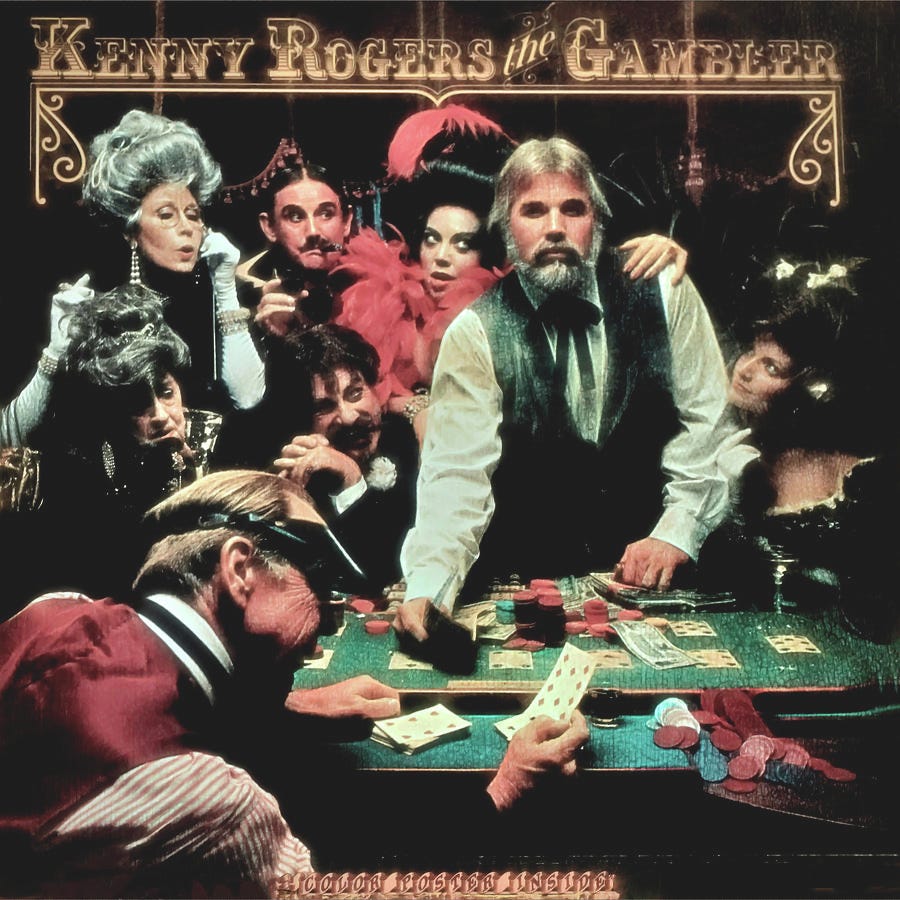
Several markets right now feel like a room you might not want to be in. Everyone is at the table, the stakes keep rising, and the hour gets late. In The Gambler (Kenny Rogers), the story unfolds on a late-night train ride, where an old card player shares his philosophy with the narrator: know when to hold, when to fold, and when to walk away.
Three rooms look shaky to me.
First, the backdrop: interest rates
The buyers of government debt are getting harder to find. The US, Japan, and France have different politics, but the same problem: aging demographics and increasing fiscal deficits with no end in sight. Our politicians seem able only to pander and kick the can down the road. The likely result is that rates stay higher for longer.
Room one: AI infrastructure
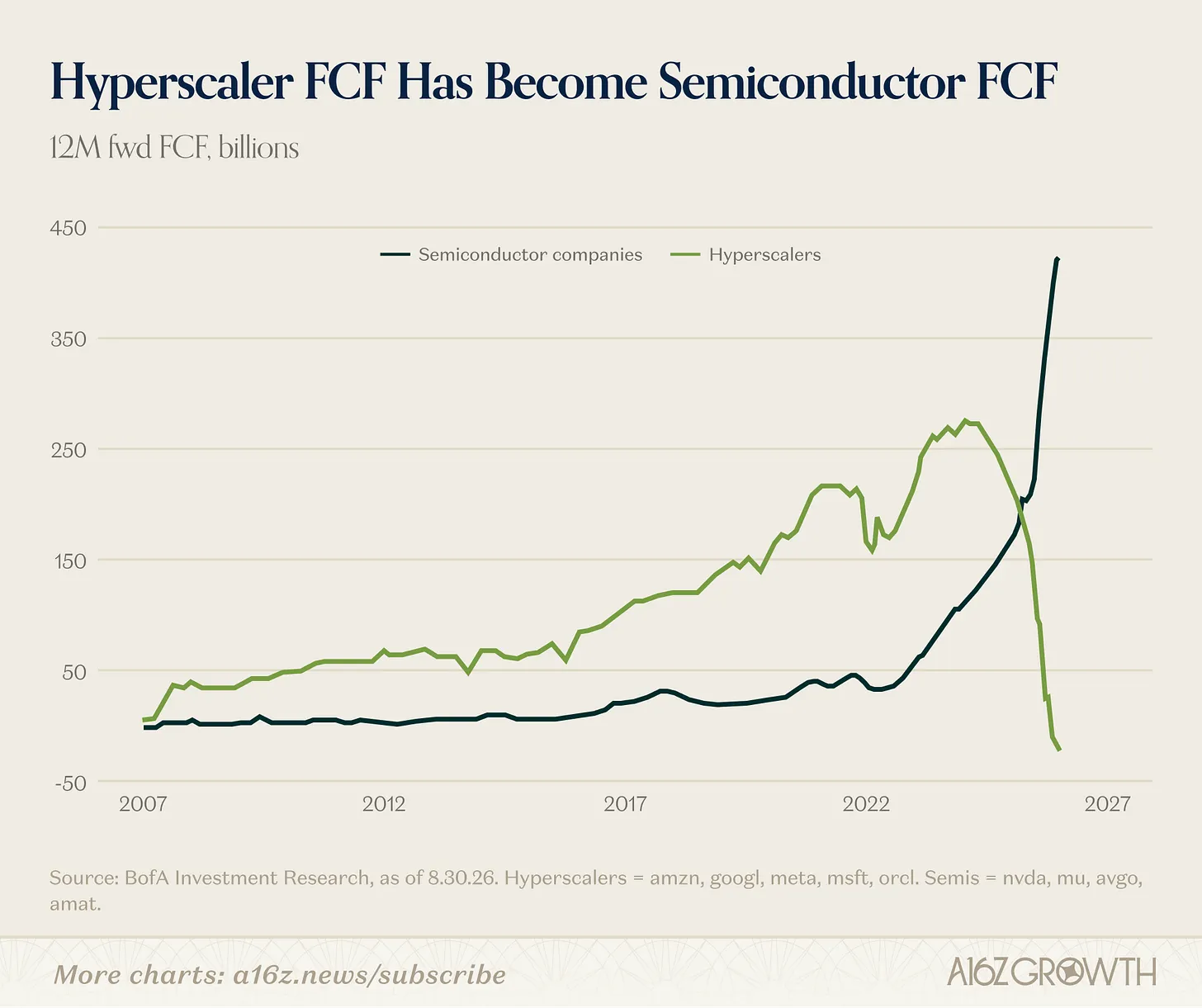
So far, the AI buildout hasn’t cared about this backdrop. When the prize is winning a winner-take-all race, the cost of money is a rounding error compared to access to compute. Hyperscalers have funded data centers from cash flow, and a few points of interest don’t change the math when the alternative is losing. Chart below from a16z State of Markets; see pp. 15–20 on the CapEx needs and the debt financing.
“Debt certainly raises the stakes, and the numbers are big, but what ultimately matters is the return on investment. For now, hyperscaler ROIC is well above their cost of borrowing.”
The statement above is true, but it omits the time dimension. When will the return be achieved? I don’t think many are truly worried about the hyperscalers, but the neoclouds and OpenAI/Anthropic are shakier, given they don’t have proven 20-year-old legacy cash-cow businesses and their compute commitments run far ahead of current revenue.
The market seems more punishing recently, as Meta announced it was diluting shareholders with a massive capital raise (up to $95B). On the flip side, hyperscaler CapEx should decrease post-buildout, reducing semiconductor free cash flow (FCF). Today’s losers (i.e., hyperscalers spending heavily) and today’s winners (i.e., chipmakers) trade places once CapEx slows.
But the money is changing. More of the marginal dollar now comes from private credit, followed by insurance balance sheets. The Ares Alternative Credit newsletter put it well:
“The most cautious pool of capital in finance (insurance) has pulled up a chair next to the most risk-tolerant (venture).
...
The collateral (the chips), the tenant's cash flow (the rents), the credit support (the vendor backstopping demand volumes), and the funding (insurance capital) are not four independent risks.”
Worth reading in full.
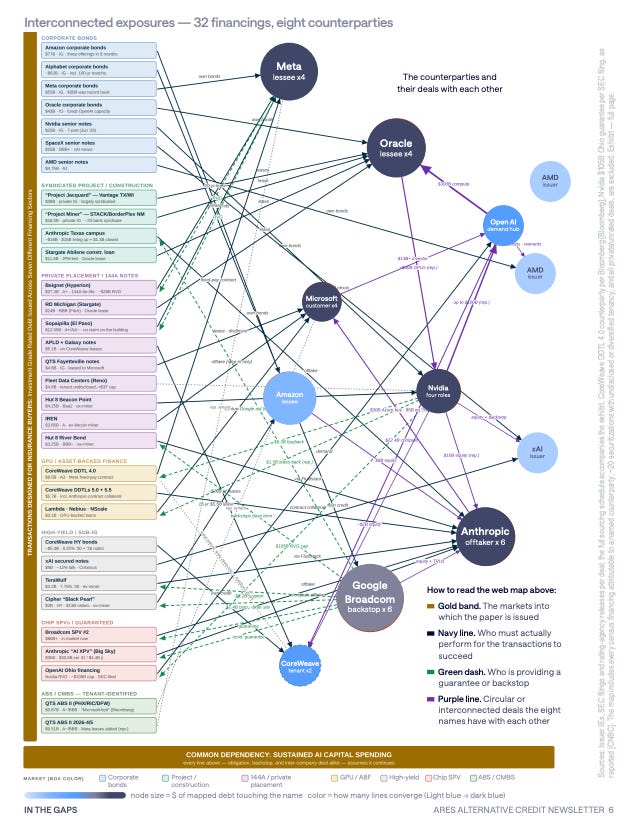
My view is the AI buildout is more rate-sensitive when marginal dollars come from insurance-backed credit rather than hyperscaler cash flow. Insurers don’t play winner-take-all. They price duration, liquidity, and rates. When they set the terms, the cost of money matters again.
Room two: venture pockets
I’ve evaluated more and more fundraises with stated revenue or revenue projections that look much scarier than room one. In several cases, I wondered what is the creditworthiness of ‘contracted revenue before hardware is deployed’? And this revenue acts as collateral against which a debt facility is drawn. Let’s say that is certainly not investment grade for this analyst.
There have recently been double-tranche rounds, or even super-quick pre-seed-to-series-A markups, for infrastructure deals in ultimately commodity markets with pricing power that seems momentary. The short-term IRRs look great. This is being done without regard to interest rate risk, commodity prices, etc.
Startup investors and founders are notoriously bad at accounting (probably on net helpful for them!), but the shakiness of revenue recognition, LOI quality, and term definitions reminds me of conversations about tokenomics back in 2021. They present these with extreme confidence, with a lot of hand-waving and ultimately risk. It’s not so important when the valuations are low, and you are playing the power law. But it matters more when the upside is 5-10x, and the downside is a wipeout.
The room with no door is private equity.
Orlando Bravo of Thoma Bravo, a $172B buyout firm, said the quiet part out loud this week: “Thoma Bravo puts a company up for sale and gets 10 bids that all look the same: a minority stake at a guaranteed 15% or 1.5x.”
Equity risk dressed with credit returns and sold to credit-type capital. The tell is the 10 identical bids on price because the value is in the preference, not in the price upside. This type of offer raises the cost of money for companies that are often already levered. A 15% accruing preference on top of existing debt is precisely the rate-sensitive structure to watch.
What am I doing?
Staying diversified and invested. Selectively seeking the uncorrelated: companies that don’t need the high-stakes table. That means businesses with real revenue from customers, capital-light models, and founders who can survive years when money gets expensive. Holding more reserve than usual. And watching for the opportunity that comes when financially engineered capital has to sell.
Also, I like liquidity. And after a few drinks or in whispered voices, many technology investors will tell you they believe the same.
Sometimes the best seat at the table is the one by the door.
Thanks for reading, friends. Please always be in touch.
As always,
Katelyn

PS. Another great Live Oak! I caught up with the same Zach mentioned above at Fresa’s. Zach is a Renaissance man: a classically trained musician, the founder of an early Bitcoin/blockchain fund, and now the owner of Ascend, a 24/7 travel concierge that makes booking travel effortless. I haven’t used it yet (soon!), but friends who have swear by it.
Zach and I are both seed investors in Boundless Life, a live-work-learn community for remote workers with kids. It’s one of my alternative education investments that people outside the industry actually know about and rave about.