
Dear Friends,
I was trying to lean into the summer lull, but there’s so much going on economically, and the cards on the table are changing.

Many market participants and fund managers are basically Tarot Card readers. Look at the cards you’ve been dealt and make up a story. Make it compelling, believable, and interesting, with the right mix of specificity and vagueness so the average person sees truth where there is mostly conjecture. Ideally, you get the recipient to tell their own story in the cards, and you affirm and amplify their existing beliefs.
It’s a skill, so I’ll try my hand.
Now, I mostly agree with Peter Lynch that ‘if you spend more than 13 minutes analyzing economic and market forecasts, you've wasted 10 minutes.’ It’s out of your control; it's almost impossible to correctly predict the second- and third-order consequences. If you’ve diversified or positioned well, it shouldn’t matter in the long term. But the cycle is changing, and the big moves in the last month or week are worth the review.
The through line is Leverage, Leverage, Leverage. Everywhere, financial systems and returns are bolstered by debt. There is a lot of hidden and not-so-hidden leverage in the financial system with options, derivatives, and complex contracts. It’s fine when there are always more buyers, when prices always go up, when interest rates are low.
There are years when nothing happens, and then a multitude of forces come to a head at once. Are we there yet? Maybe. Probably. Time will tell.
The doomiest leverage chart:
The US hasn’t had real growth since before the great financial crisis because deficits have mostly been unproductive. Deficit spending makes the US feel like a rich country while its institutions decay and everyone feels like they're never getting ahead.
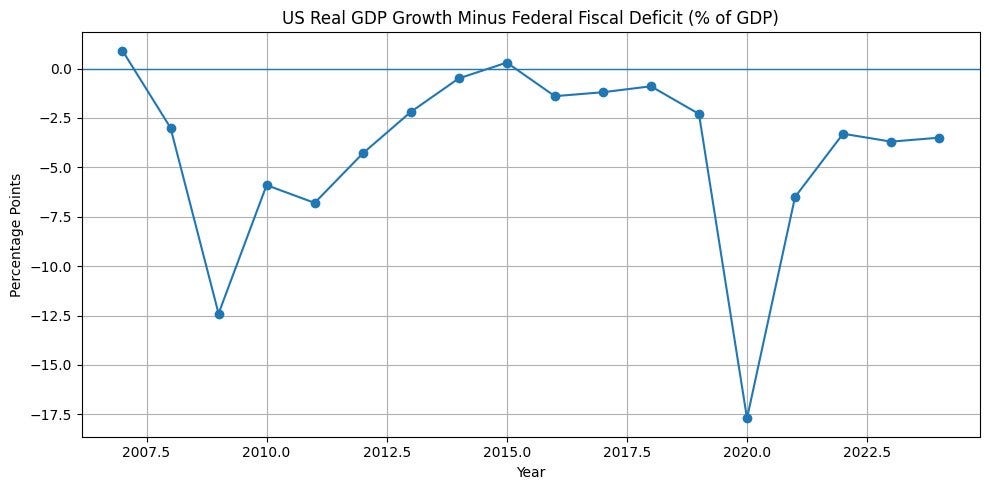
That’s the last 20 years, so what happened this week?
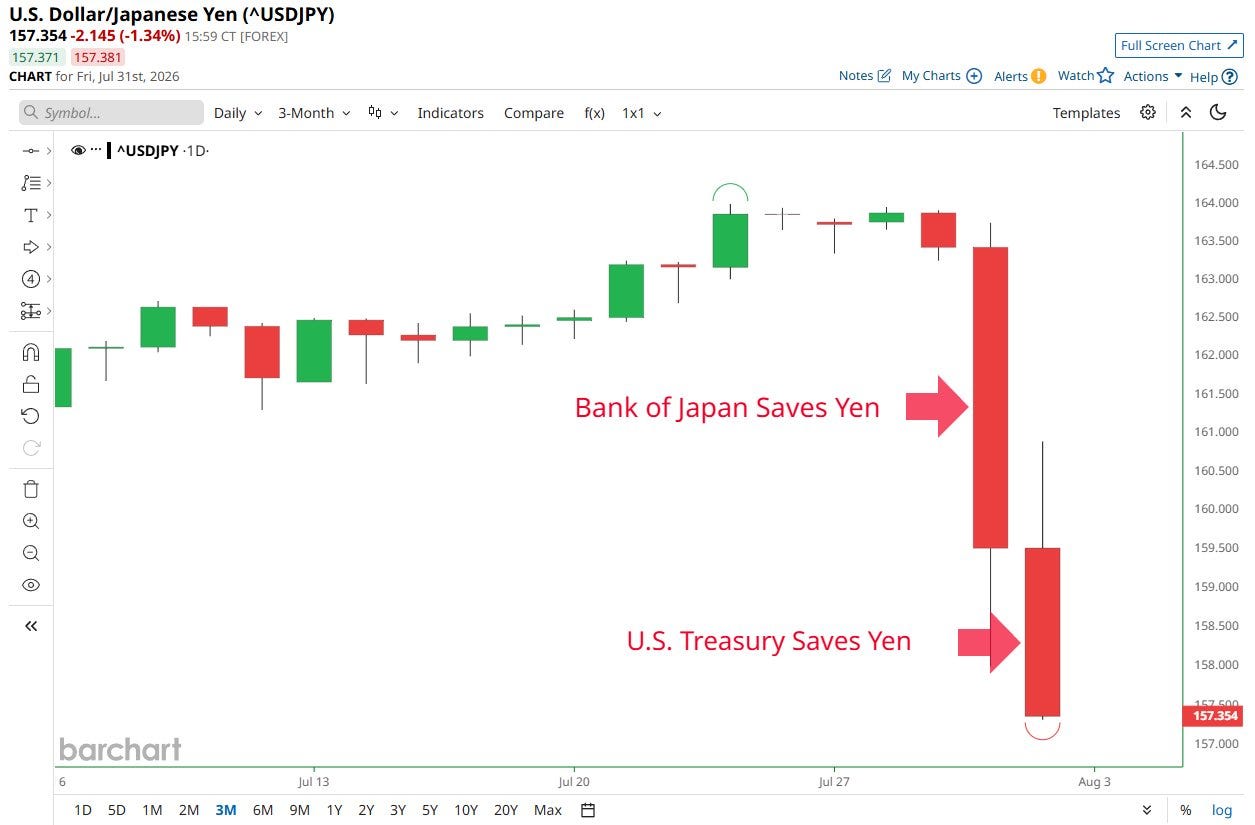
1.) The Japanese Yen was supported by US Treasury intervention on Friday
The Japanese government bought roughly $58 billion of their own currency, and it was reported on Friday that the US joined them by selling euros to buy yen. This is the first coordinated intervention since 2011. The big picture here is that for the last 30 years the Japanese economy has hardly grown, their national debt has expanded, and they’ve kept interest rates near zero. All has been well until now. Maybe demographics have finally caught up with the country and inflation is rising everywhere. Notably, Japan is the largest foreign holder of US Treasuries with a $1.2 trillion position (the UK is a close second-largest holder).
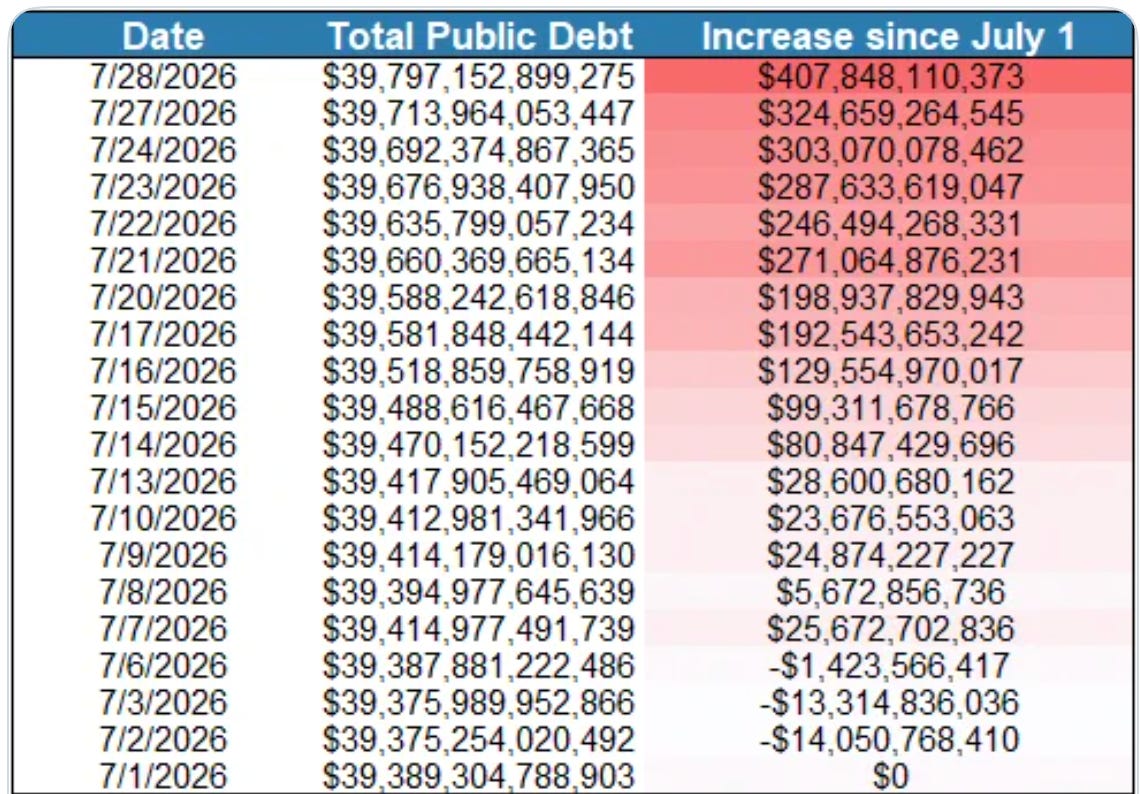
2.) US Government Debt nears $40 trillion with $407 billion of deficits in July alone.
It’s common knowledge and widely agreed that US deficit spending has spiraled out of control, and there is zero political will to rein in the spending or the obligations. Many have taken refuge in Modern Monetary Theory, which says deficit spending mostly doesn’t matter and, in fact, is good if it results in growth. But it’s unclear that any of this spending is doing that. Entitlements are not big growth drivers, and defense spending is mixed - often positive in the short term and damaging in the long term. Politicians and most of the public seem not to mind getting to the reckoning day faster. And reckoning might be here.
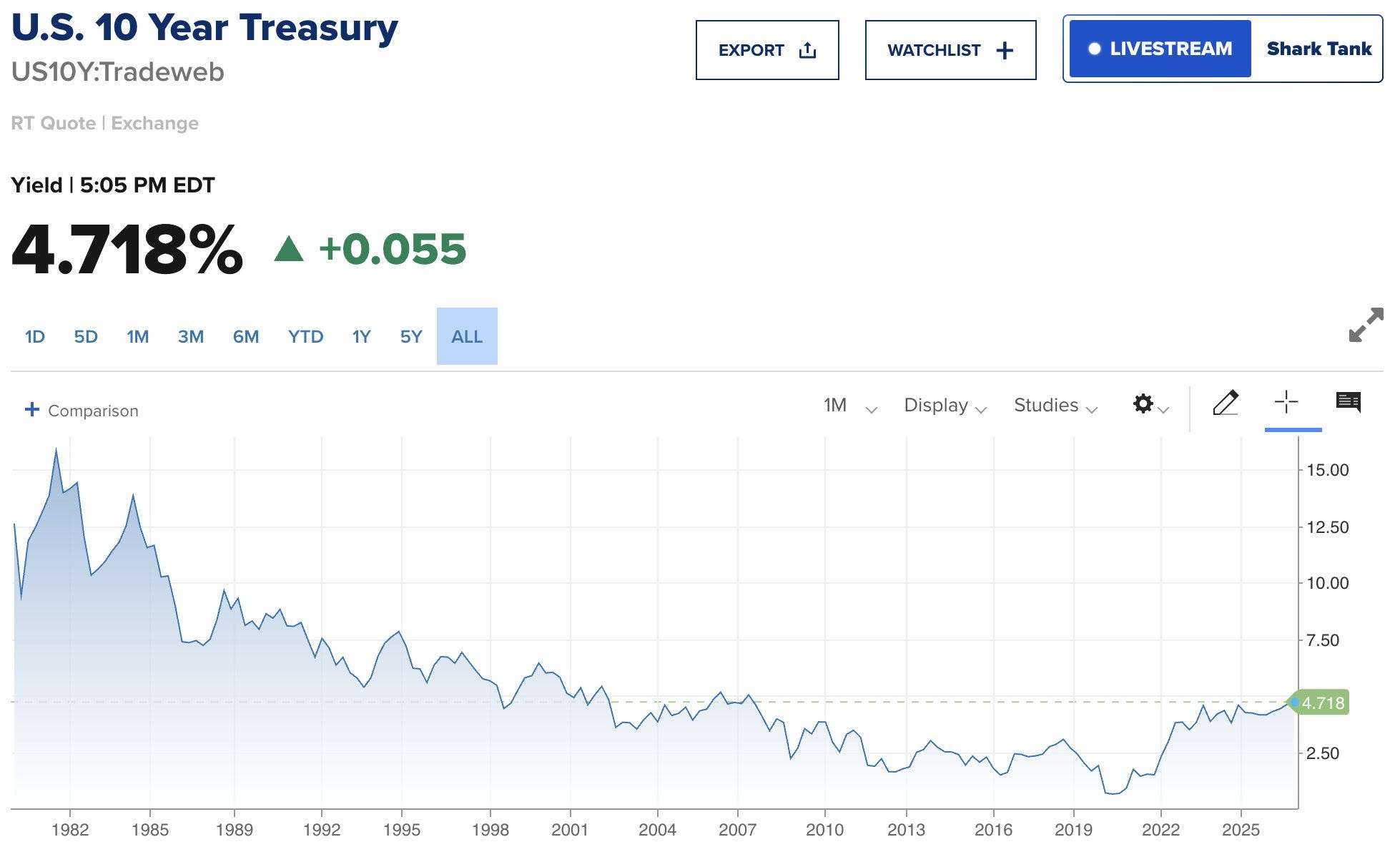
3.) The Fed held. The 30-year rose anyway.
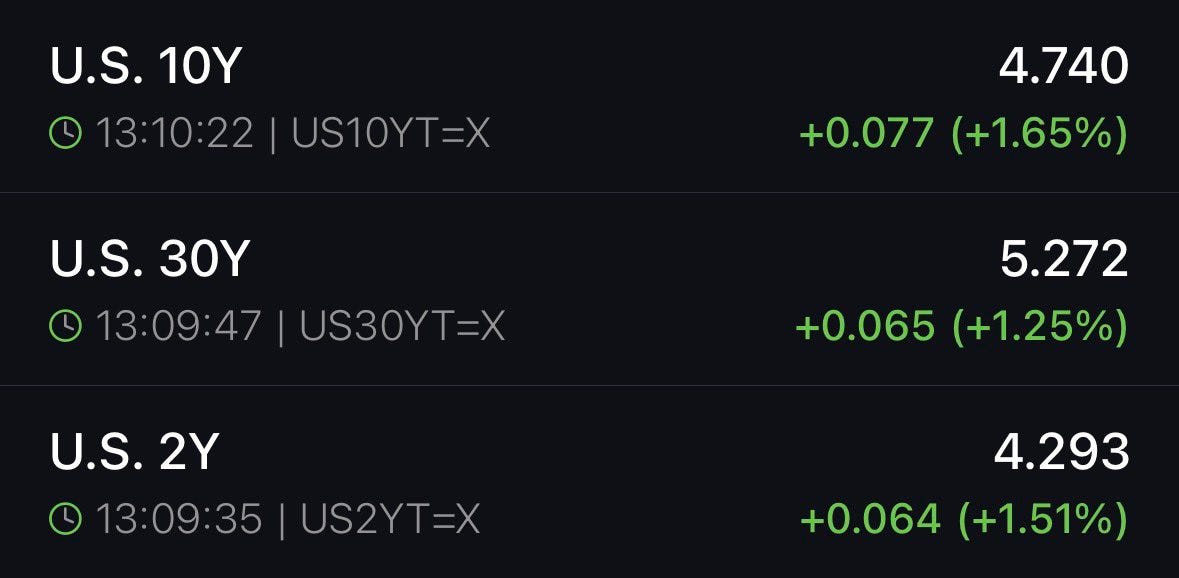
The Fed announced that it voted to keep interest rates the same; it was a 9-3 vote with three dissents to hike. The 30-year interest rate rose ~12 basis points to levels not experienced since 2007. This has many downstream implications for the mortgage market and the cost to service government debt.
4.) War in Iran is unwinnable and unpredictable
The war in Iran is a misjudged foreign policy disaster. It’s achieved almost nothing substantial that the public can see; it’s made passage of Hormuz a toll-booth given the Iranian choke-hold, and it’s a farce of on-again, off-again peace and cease-fire actions. Every action seems to be front-run by those with information and curiously happens outside market hours.
Throughout the Iran conflict, those who believe “Trump Always Chickens Out” (TACO) have been right. I agree: Trump will indeed keep playing his game. But the state of play is evolving and becoming irreversible. The Iran conflict is escalating in cost as munitions and other supplies are depleted. Interest rates, oil reserves, and the debt may force Trump and the military’s hand.
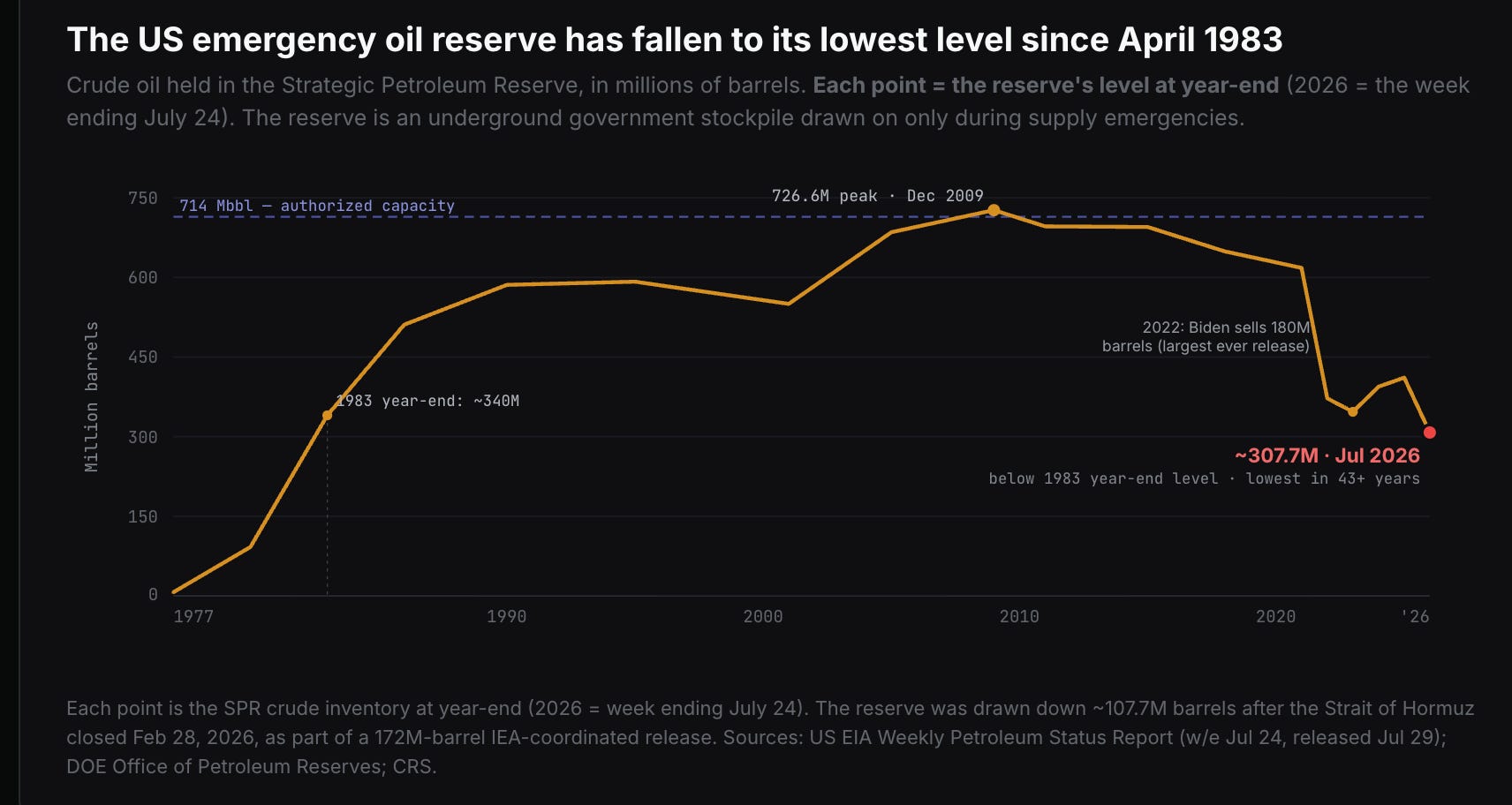
5.) US Oil Reserves have reached levels not seen since 1983.
One of my friends said ‘the market has not priced this in’ and I agree. It has not. The market doesn’t really believe that any real crisis will happen because at this point it’s like the boy who cried wolf. No real crisis or material shortages have happened…yet. But supplies are declining, prices rise when they do, and oil is an input cost to everything. Inflation pressure first, rate pressure next.
Just monitoring the situation.
6.) Situational Awareness & Fund Leverage
Situational Awareness, the high-performing hedge fund run by Leopold Aschenbrenner based on his paper with the same name, was margin called. After two years of stellar returns driven by amazing calls on public equities benefiting from the AI infrastructure build-out, he achieved something like 270% net of fees through May, then a $45 billion peak down to roughly $10 billion, 4x gross leverage, and margin calls from Goldman, JPMorgan, and Bank of America.
It’s being reported that most of the public portfolio was sold to Citadel to meet the margin call, and the Anthropic private position, which was unlevered, remains. Prime brokers can't margin a position with no daily mark, which probably saved the fund. The lack of liquidity is a feature of private markets that can save managers and mask underperformance.
7.) Korea & Retail Leverage
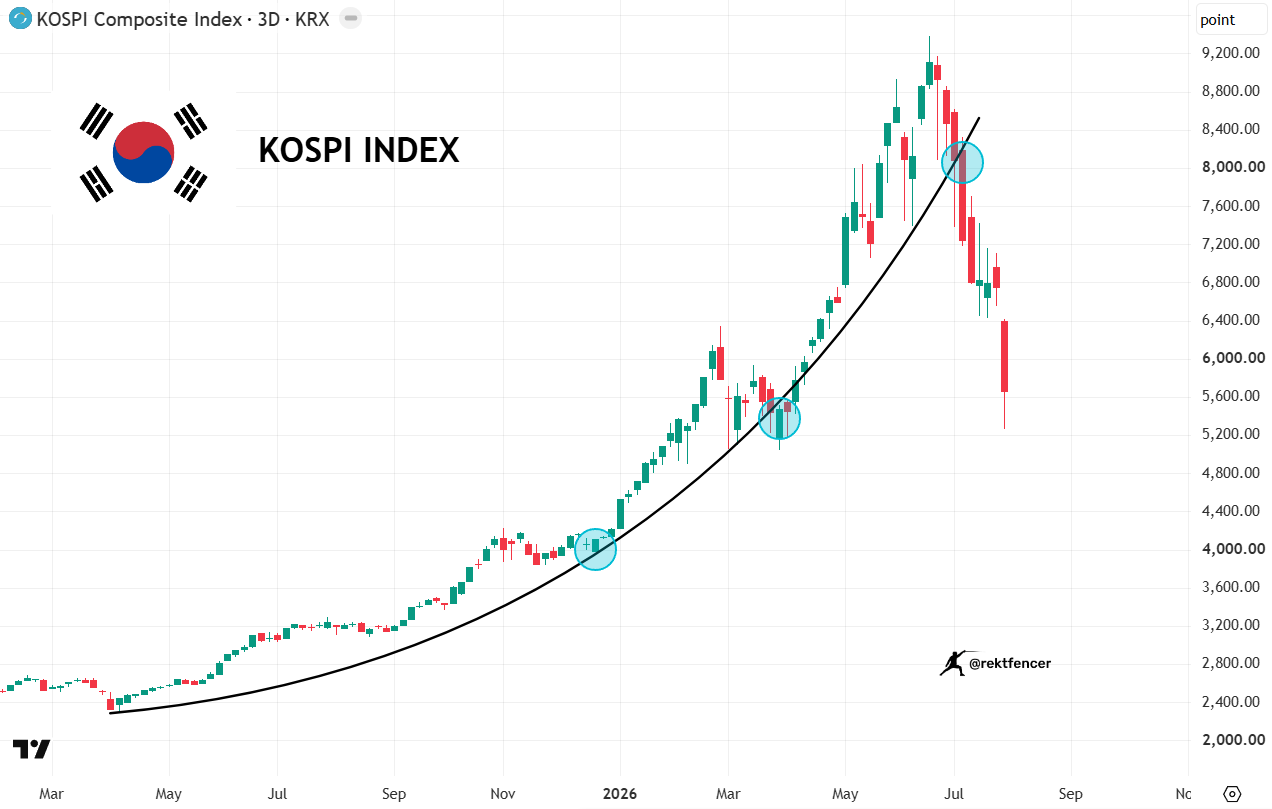
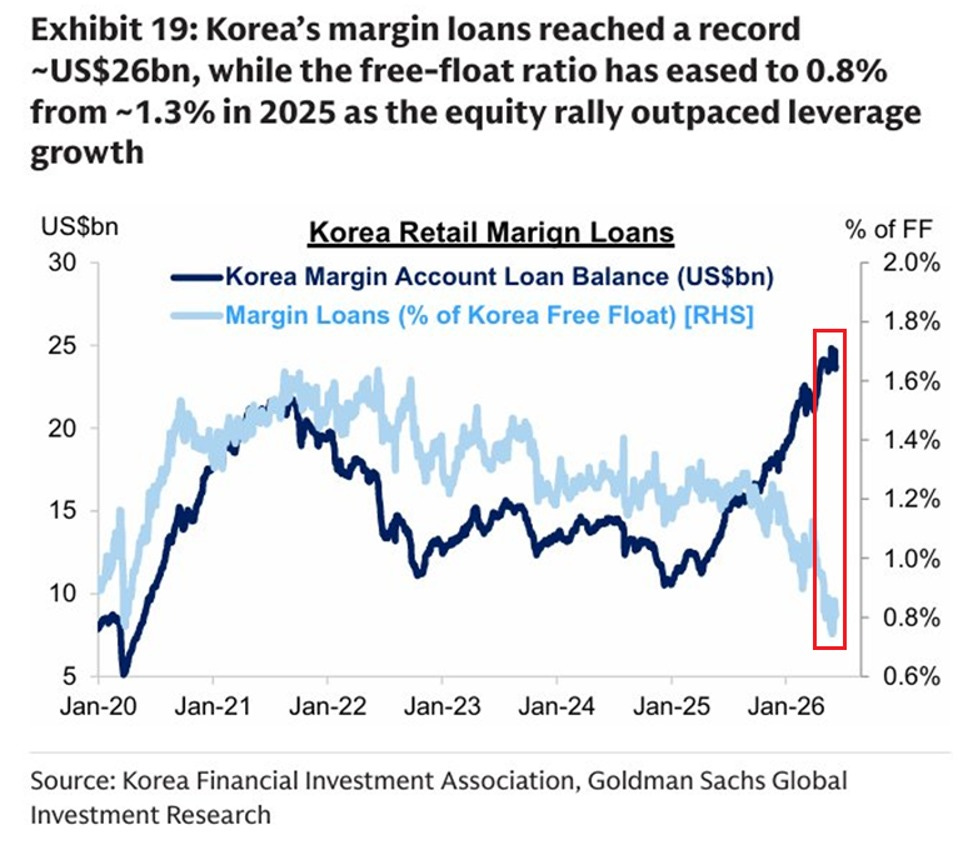
The Korean market might be crazier, though. Long story short: The Korean market has been on fire this year, driven mainly by the frenzy around semiconductors. The run-up reached classic bubble dynamics through leverage amplifying the upward momentum. The specifics? The KOSPI hit an intraday record of 9,386 on June 19 and closed at 5,663 on July 29, shedding ~40% in six weeks. This week we saw 2.3 trillion won of forced retail liquidations, and the KOSPI’s eighth circuit breaker of the year.
Good Luck!
Good Luck, Babe! was Chappell Roan's breakout single. It’s about wishing good luck to someone who is denying their true romantic feelings. In our context, the flippant refrain - Good luck, babe (Well, good luck) - is for those trying to deny the impact of the massive macro forces that are out of any one person’s control now. I wish us all good luck.

We can emerge stronger from crisis. If you, like me, are mostly indexed in low-cost funds, you haven’t felt the speed bump. Diversification is protection because no one knows when or how all of this breaks. These times reinforce the timeless values: Live below your means; don’t gamble; be most skeptical of charlatans and get-rich-quick schemes. Good financial practices in the long term pay. Plus, the pace of tech innovation is still staggering, and that always pushes humanity and wealth forward.
There has still never been a better time to be alive.
Thanks for reading, friends. Please always be in touch.
As always,
Katelyn
Naver Finance (naver.finance) is an... interesting platform to read discourse, seeing that 30% of Koreans are active retail traders, seeing how many got liquidated gave me a newer appreciation for Squid Game.
There isn't a single example documented of a successful effective altruist led fund.