
Dear Friends,
I hope you are gearing up for summer and sun wherever you are (or winter for those of you below the equator). I don’t think it’s going to be a sleepy season, but we will see!
Today's Contents:
Sensible Investing
Weeklies: Picture & Song
Sensible Investing
After watching the markets surge forward the last two weeks, as companies with already large market caps rip (e.g., Dell up ~60%), Google raises $40B in equity (25% funded by Berkshire), and the march toward the SpaceX IPO continues, who among us didn’t consider liquidating their holdings? Then you remember: “I’m not a market timer.” And, worse, the taxes! After many decades of growth, there are incredible unrealized capital gains in funds tied to these indices. The hit (or revenue from governments in search for more to spend) would be huge.
But if you wanted to be fearful while others are greedy, the time is now.
On SpaceX, I (like you, I’m sure) have read all the stuff (S-1, the CFO’s presentation, Aswath Damodaran’s analysis, the Cathie Wood-esque projections coming from GS and Morgan Stanley (LOL)) and concluded that it’s an incredibly impressive engineering, space, and internet connectivity business with good revenue, decent growth, and reasonable margins. Yet the valuation seems to rest on the slapdash, tacked-on AI business requiring capital investment, unclear payoffs, and last-minute Anthropic and now Google compute agreements with more holes than Swiss cheese to keep the revenue round-tripping number-go-up machine aloft (or, one might say, the infinity and beyond).
Almost all of SpaceX's AI activity has been a series of rapid announcements over the last 6 months, starting with the surprise acquisition of X.ai/Grok. Back in 2024, at $350B, the valuation was high but more reasonable. Today at $1.7T with the extras, what’s the upside? And on what timeline at this price?
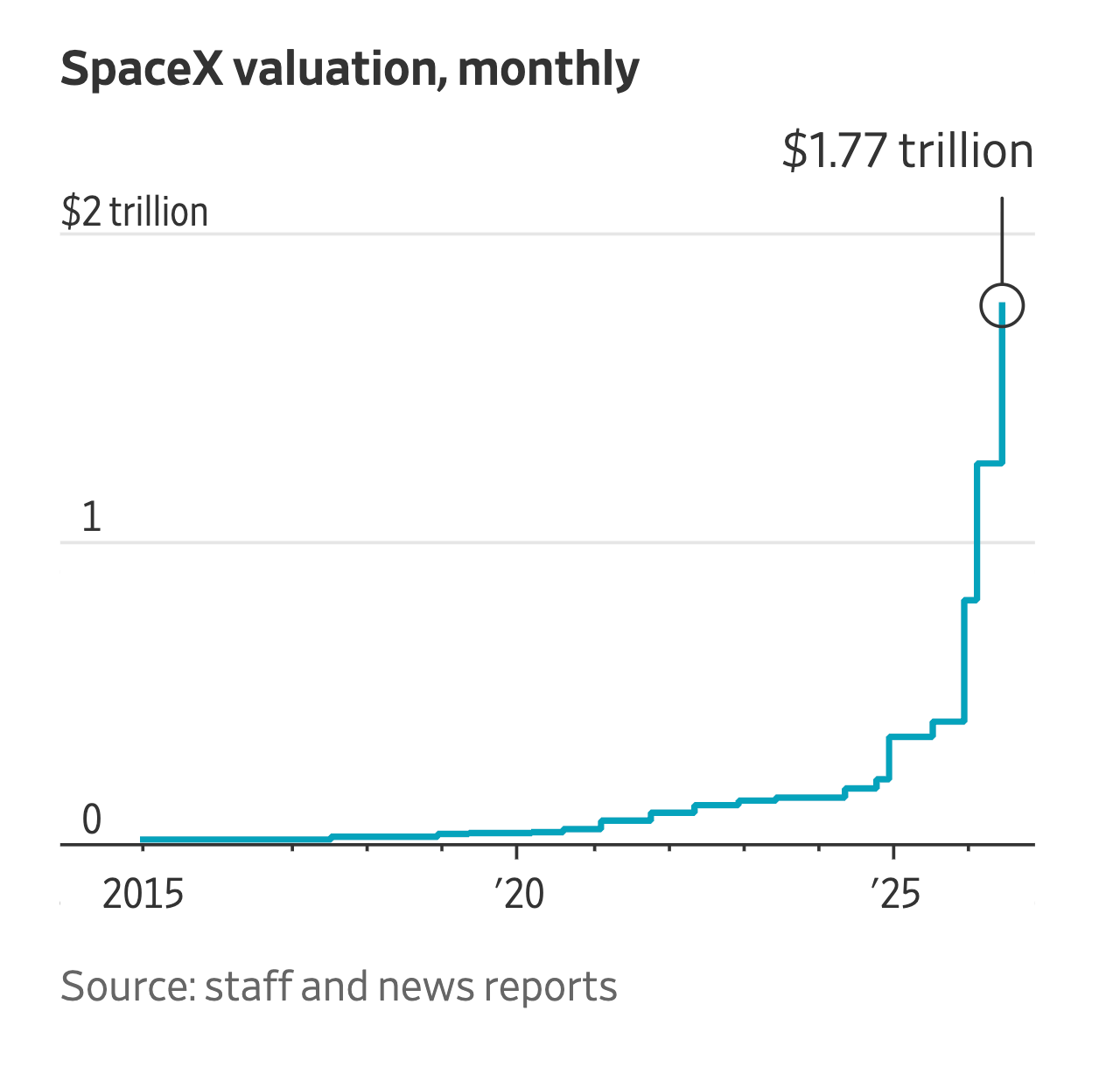
The Physics of SpaceX by Blind Squirrel Macro provides a good analysis of the offering's mechanisms and puts on the table a ‘Plan B’: a reverse merger of SpaceX into Tesla.
Even if I’m not an IPO buyer, I don’t want to come off as too negative, because it’s objectively awesome for Austin and many of my venture friends to have this much wealth unlocked. Evan Baehr, CEO of Arena Hall and perpetually in the know on these sorts of things, has estimated (via Chris Powers) that if the SpaceX IPO goes ahead, 12 people in Austin will clear $1B+; 160+ will clear $100M. It’s another catalyst for the Texas Triangle, as The Economist notes, ‘Texas is becoming America Inc’s center of gravity.’
I will, however, offer this: the process of changing the Index inclusion rules has been unsavory. When benchmark rules are adjusted around mega-cap listings, passive investors are validating the price that private markets and bankers already set. There are endless conflicts of interest around these waivers.
Bloomberg Intelligence estimated S&P 500 funds would absorb 19% of SpaceX’s float within 6 months, which is no longer the case, as the committee decided against changing any of their inclusion rules. The Russell 1000 and Nasdaq 100 funds will still absorb 24% and have amended their rules. Nasdaq is taking the allocation faster, which makes more sense because its tech/growth focus - and given the exchange is listing SpaceX.
Beyond SpaceX, we potentially have multiple massive, $1T+ IPOs coming to market from Anthropic, OpenAI, and others, who may be emboldened by the market's openness to absorb large capital needs at exceedingly low cost.
The question is what happens with the credibility of indexes and the returns of passive investors? The market structure, passive/active distortions, and rule changes are transforming how the ETF market functions. It’s been a big month on the topic generally as the Acquired guys covering Jack Bogle and Vanguard and VOO (Vanguard’s ETF that tracks the S&P 500) crossed $1T AUM, an industry first!
The chief investment officer at Vanguard Capital Management and the head of global equity at Vanguard wrote this article in the FT Index Investing Will Evolve With Mega IPOs (PDF), published a few hours before the S&P committee ruled it would not change its criteria. It says little definitively but was intended to shore up support to stay the course amid discontent among passive investors. The comments are scathing.
This is the time for the re-evaluation of passive investing and the acknowledgment that, behind ETFs, there is certainly a set of highly active decisions aimed at broad-based diversification. Some of which you may agree with and some of which you may not. If the passive system becomes gamed by financial engineers, as it seemed poised to do, and no longer delivers for retail investors and retirees, that will be a sad day, but maybe an opportunity for reinvention.
Weeklies: Picture & Song
Picture
I’ve noticed this trend in Austin, where two women go walking the trail together, looking nearly identical! Do you think they planned it? My guess is probably not, which makes it more intriguing.


I really want to make fun of the twinning girls of Austin and their lack of originality, but I also suffer from matchy-matching with my own friend. And the sad fact is that you can’t be cool wearing transitional lenses.

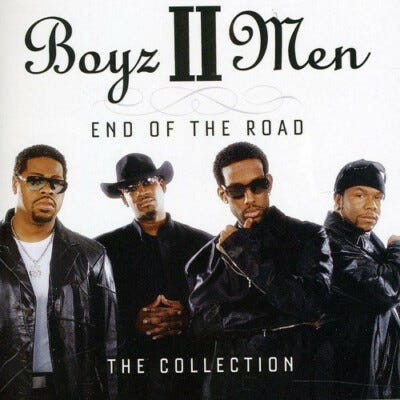
Song of the Week: End Of The Road by Boyz II Men
Here on YouTube.
Boyz II Men are the ultimate 90s R&B group. Their songs should be played more often in our modern times.
End of the Road is an emotional ballad reflecting on a shared love while acknowledging that the relationship has run its course. It's sad, but also respectful and grateful, which is appropriate for how I feel about passive investing and Vanguard. To be clear, I’m not selling my ETFs, but I might use a different platform for direct indexing with more control going forward. If only the fee structure were better…
Thanks for reading, friends. Please always be in touch.
As always,
Katelyn