
Dear Friends,
Yes, yes. Sorry, I missed a couple of weeks. I turned 40. I led 30 investors on a deep tech tour of Austin (massive success, let me know if you want to join on the next one). And, sadly, my Grandfather passed away at 93. Among other losses, Grandpa Bruce was at the top of the leaderboard in terms of engaged subscribers, so I’m going to need a few of you to step up and fill the gap.
The more you step away from the Internet and your desk, the more you realize how absurd and extreme everything you read online is to capture your attention. Everything is doom, dire, and dramatic, but it hasn’t seemed to impact your actual life all that much. See, for example, half of LinkedIn posts the last few days started with ‘Jack Dorsey cut 40% of jobs at Block this week…’
Today's Contents:
Sensible Investing: Claude & AI
Weeklies: Selfie & Song
Sensible Investing
Good news or bad news. I finally went all-in on AI a few weeks ago and spent 20+ hours with my new friend, Claude, over 48 hours.
I’d obviously been using AI in various forms before, but this is the first time I uploaded all of my private writing and hidden files. We had a long conversation.
Why Claude, you ask? Well, of the various characters to (sort of) trust with your information, the brother-sister duo with their Effective Altruism nerd friends seemed the best. And Opus 4.6 is not disappointing.
Claude had a lot to say about this newsletter. First, it thinks my private writing is 50% better, and that I’m holding out on you by providing too many links and not enough original analysis. Second, it thinks I have too many long quotes. Third, it likes the selfie more than the songs, but thinks that when the songs are well-explained, they are good, and the concept should stay. It’s an interesting mirror.
One of the debates that kicked this off was a few articles:
Something big is happening, or is something big happening? (AI Is Not Covid) You decide. Personally, I’m more aligned with the second piece, but I agree that these tools are improving every day, and there’s no excuse not to kick their tires and see what they can do. This, on AI Mania, was how Paddy from Because The Internet cleverly described it.
It’s way better at compiling, summarizing, and analyzing information. Of course, the information has to be good, and your relative weight or impact of what is important is critical to it. This can make AI draw dramatically different conclusions from the information presented, and it is here that you feel the outer limits of its capabilities.
All of this makes the ability to think critically and the willingness to implement the recommendations critical. I’m going to focus on the pre-existing issues with critical thinking.
AI Hurtles Ahead is the newest Howard Marks memo co-written by Claude. I guess we went down the same rabbit hole. Here is Marks’ take on whether AI is a good investor.
In other words, AI possesses a lot of the qualities one needs to be a good investor.
On the other hand, it’s missing a few things. Great investors are much more than fast, unemotional processors of data. They have to be strong exactly where Claude admits AI might be weakest: in dealing with novel developments where there’s not enough prior experience for dependable patterns to have been compiled (and learned by AI during its training). They also have to make subjective decisions regarding qualitative factors and exercise taste and discernment. For instance, choosing the right counterparties has played an important part in Oaktree’s success.
AI is going to kill all jobs is the dramatic take. But not my job, that’s the consensus take. And that consensus will probably be right.
AI Makes Everything Political
Another implication of AI is that everyone will have to start caring more about politics. You can already see the wagons circling around regulations and job protections, which were short-term measures intended merely to delay long-term pain.
Over 50% of GDP is in a highly regulated sector, and almost all job growth in recent years has come from these areas (local government, education, healthcare). I was talking to a friend who recently led a workshop to introduce AI to local government leaders; she said they were scared to even enter a simple prompt into the interface.
When I asked Claude to get specific and evaluate my thesis, it produced the following:
Highly regulated sectors as a share of US GDP (rough but defensible breakdown):
Healthcare: ~18%
Financial services & insurance: ~8%
Government (federal/state/local): ~12%
Utilities & energy: ~2%
Education: ~6%
Defense/aerospace: ~3.5%
Telecommunications: ~3%
Transportation (airlines, rail, trucking): ~3%
Construction (heavily code-regulated): ~4%
That gets you to roughly 55-60% of GDP in sectors with heavy regulatory overlay. If you include agriculture (subsidies, USDA), pharmaceuticals specifically, and real estate (zoning, permitting), you’re pushing toward 65%+.
The punchline: the majority of the US economy is already politically mediated. AI just makes that fact visible and consequential to a much larger share of workers. The people who used to think “politics doesn’t affect me” because they worked in tech or consulting are about to discover they were wrong. They were just in the temporarily unregulated sectors.
Back to me:
This is why smart capital is already positioning itself around government-adjacent value chains (e.g., ‘American Dynamism’, ‘Accelerating the GDP of America’). The implementation gap between the private and public sectors is wide. The need for better, smarter public systems and public sector leaders is dire.
Besides jobs and government, the role of capital (and its abundance) is worth reflecting on during the AI transition. Fahd Ananta had a nice piece on Death by Venture Capital on how too much capital raised kills venture-backed companies. Feels like there is a lot of that going on these days.
There are also business models being underwritten to venture standards that are still fundamentally services or so capital-intensive that returns will be low due to dilution (hard tech is hard!).
Below is my co-written Claude contribution comparing Multiverse & Andela (the unicorns who raised hundreds of millions) with Delivery Associates (the business I co-founded with no outside capital). I often find myself asking founders: Do you want to make money and build value for yourself and your team, or do you want to play a status game? Most choose status and then build the non-VC mirage business anyway, which is doomed to fail.
The Services Masquerade: Lessons from the SoftBank/Tiger Era. The 2021 venture capital boom produced a specific and recurring failure mode: fundamentally services-oriented businesses that raised and spent capital as though they were software companies.
Weeklies: Selfie & Song
Selfie: Cacao, Andrea, Third Eye
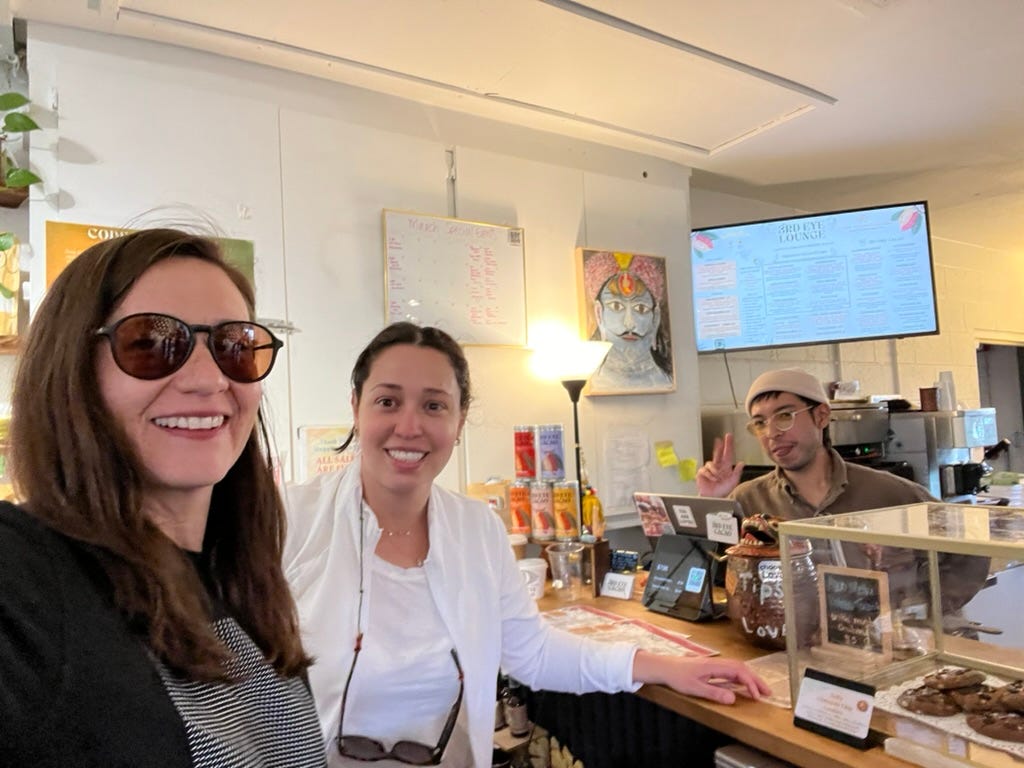
My friend Andrea was in town, and we walked around Town Lake and wandered into Casa de Luz and Third Eye Lounge, which, as we learned, is the headquarters for ceremonial-grade cacao here in Austin.
We asked the gentleman behind the counter what beverage would be a good intro.
He said, ‘I’d start with a grounded presence.’
For a second or two, we took him literally…but it’s just the name of one of the offerings. We indulged. There is truth in advertising: it was delicious and grounding.
My friend kindly offered to buy a bag of raw cacao from Colombia. Suspiciously, none of the products had stated prices. Turns out, spirituality is expensive!
Song: Amarillo By Morning

Here on YouTube.
The song is sung from the point of view of a rodeo cowboy, driving at night from San Antonio to a county fair in Amarillo, which will begin the following morning. The man recounts the hardships his occupation has caused him, including divorce, broken bones, and poverty, but states that he does not regret his lifestyle: "I ain't rich/ But Lord, I'm free." The song has appeared in several lists of the best country songs.
I was introduced to this song at Donn’s Depot a month or so ago. I love the Americana themes of freedom & open road, resilience & optimism, and loss & sacrifice. It’s classic Texas country storytelling and the spirit of the American frontier that underlie so much of the entrepreneurial activity here in Austin.
It also reminds me of my grandfather's era and how fleeting it all is.
“Amarillo by Morning” by George Strait (Cover of song by Terry Stafford and Paul Fraser)
I ain't got a dime
But what I've got is mine
I ain't rich
But Lord, I'm free
Thanks for reading, friends. Please always be in touch.
As always,
Katelyn
happy birthday! Coogan's more astute at articulating reality, but as we see with algorithms, the more extreme sentiments get 84m impressions versus 300k. Living to 93 and being able to read likely is a great longevity sign for you!
I think Cowork has been a very easy recommendation to many, especially those around my age. What's very surprising to anyone older than 26 is that many around my age have no clue how to navigate a file system ~ I attribute that somewhat to the prevalence of Chromebook and cloud based systems in schools, but people have found a ton of value from using Cowork to better navigate their compute.
I think Claude will expand into a more omniscient Cowork by year end.